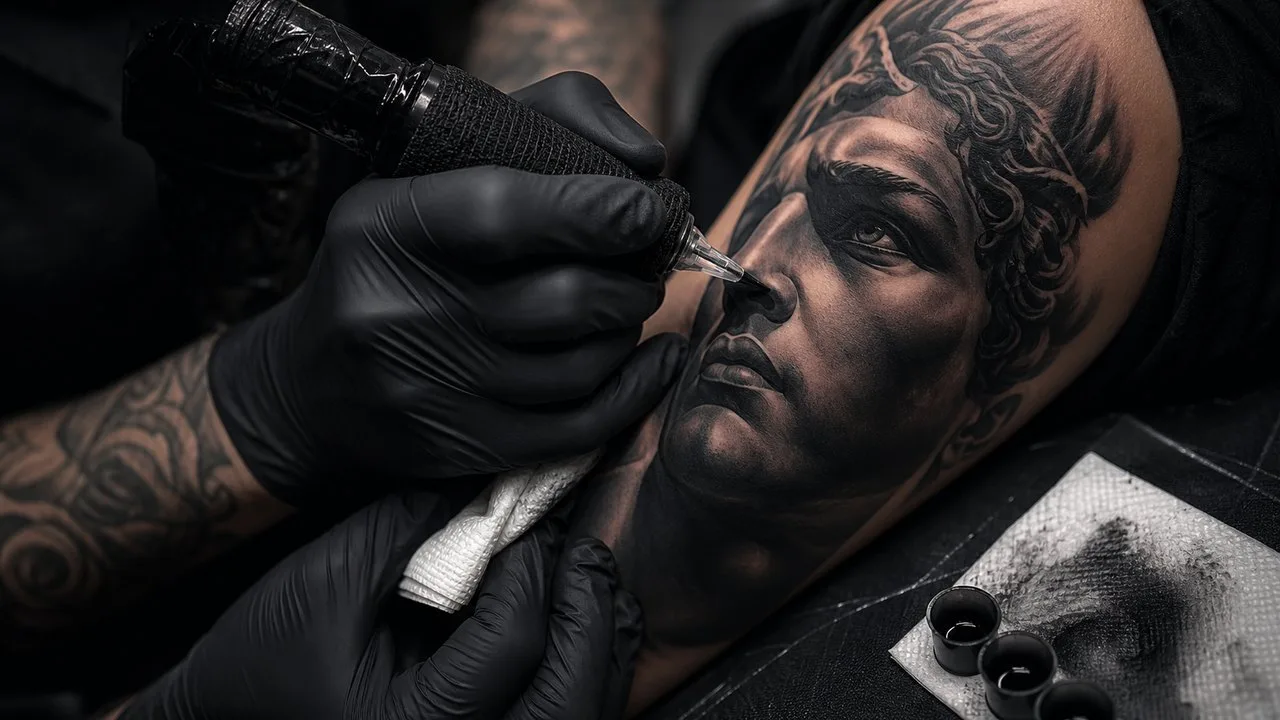
Realism tattoos: the technical process, black & grey vs colour comparison, best placements, price guide and how to choose a specialist artist.

Quick answer: Realism tattooing is an advanced style that aims to recreate a photograph or subject on skin as accurately as possible. Portraits, animals, nature and objects are the primary subjects. It requires long sessions, high artist skill and careful aftercare — and is not suitable for a first tattoo.
SameDayTattoo expert note: Before a realism tattoo we analyse your reference photo: we assess how light, contrast and detail will sit on the skin. We match you to our black & grey or colour realism specialist and plan the sessions together.
What Is Realism Tattooing?
Realism is one of the most technically demanding styles in tattooing. The goal is to reproduce a subject's dimensions, colour, shadow and texture so precisely that it gives the impression of a real photograph when viewed on skin.
Realism tattooing divides into two main branches:
- Black and grey realism: Uses only black, grey tones and white highlights. Classic portraits and animal tattoos typically fall into this category.
- Colour realism: Uses a full colour spectrum. Botanicals, nature scenes and coloured portraits are created in this style.
How Realism Tattoos Are Made: The Technical Process
- Reference selection: A high-resolution, well-lit photograph is essential. Good realism cannot be achieved from blurry or low-quality references.
- Transfer: The design is transferred to skin using transfer paper and the client approves the placement.
- Outline: Main contours are drawn very finely — realism has no bold outline.
- Shading: The longest phase. The artist works grey/black tones in layers; depth and dimension are created here.
- Colour (if applicable): Colour layers are added over the shading.
- Highlights (white): Light points are emphasised with white ink — this step elevates the realism to its peak.
Realism Style Comparison
| Feature | Black & Grey Realism | Colour Realism |
|---|---|---|
| Colour use | Black, grey, white only | Full colour spectrum |
| Session length | 3 – 8 hours (medium-large) | 4 – 12 hours (medium-large) |
| Pain level | 6/10 | 7/10 |
| Fading over time | Slower | Faster (UV affects more) |
| Care difficulty | Medium | High |
| For first tattoo | ❌ Not suitable | ❌ Not suitable |
Best Placements for Realism Tattoos
| Placement | For Realism | Notes |
|---|---|---|
| Upper arm / bicep | ✅ Excellent | Wide, flat surface — ideal for portraits |
| Back (upper and lower) | ✅ Excellent | Largest canvas area |
| Chest | ✅ Very good | Requires careful positioning |
| Forearm | ✅ Good | Suitable for small-medium realism |
| Calf | ✅ Good | Large surface, ideal for shading |
| Hands and fingers | ❌ Not suitable | Detail is lost, fades quickly |
| Joint areas | ⚠️ Careful | Bending distorts the image |
How to Choose a Realism Artist
- Specific realism portfolio: You want to see the artist's realism work only — "does everything" artists are usually not specialised.
- Experience matching your subject: An artist who draws portraits uses very different techniques from one who draws animals. Look for work matching your specific subject.
- Request healed photos: Fresh realism always looks great. A photo taken 3–6 months later shows the true quality.
- Expect a thorough consultation: A good realism artist examines your reference photo, recommends placement, and can say "I can't do this" — that's a sign of integrity.
Realism Tattoo Pricing
| Size / Subject | Estimated Time | Istanbul Price Range | Europe Comparison |
|---|---|---|---|
| Small (5–8 cm, simple) | 1.5 – 3 hrs | €80 – 130 | €250 – 450 |
| Medium portrait (10–15 cm) | 3 – 6 hrs | €130 – 260 | €400 – 900 |
| Large portrait / animal (15–25 cm) | 5 – 10 hrs | €260 – 500 | €800 – 2,000 |
| XL / sleeve piece | 10+ hrs | €500+ | €2,000+ |
Realism-Specific Aftercare
- First 24–48 hours are extremely sensitive — make sure nothing touches the tattooed area
- Heavier scabbing is expected in dense shading areas — this is normal
- SPF 50 is critical for colour realism — colour pigments fade faster than black/grey under UV
- Your artist will typically recommend a check-up/touch-up after 3–6 months — don't skip this
- Significant weight change or muscle growth can distort large realism pieces — consider this before placement
How the Process Works at SameDayTattoo
We move every step from idea to healing transparently and on a plan:
- 1. Reference photo analysis — We assess the contrast and detail of your photo and suggest the composition that sits best on skin.
- 2. Artist & technique — We match you to a black & grey or colour realism specialist and confirm the technique.
- 3. Session plan — We plan the number of sessions by size and detail, splitting long work with breaks.
- 4. Detailed aftercare — We give specific aftercare and sun protection so shading and detail last.
Frequently Asked Questions
Does realism tattooing hurt?
Yes — realism is generally among the more painful tattoo styles. Long sessions and intensive shading increase cumulative discomfort. Pain levels run 6–7/10 and tend to intensify with fatigue over multi-hour sessions.
How long does a realism tattoo session take?
It varies with size and complexity. A small-to-medium portrait takes 3–6 hours; a large face or animal can take 6–10 hours. Very large pieces require multiple sessions.
What makes a good reference photo for realism?
High resolution (at least 1000px on the long side). A single good light source — complex or flat lighting is difficult. Sharp focus. Images without busy backgrounds. Best to have the artist review and approve the original photo.
Is realism suitable for a first tattoo?
No. Realism demands long sessions, significant pain and complex aftercare. It should only be considered after at least 1–2 tattoo experiences — both for the experience level and the placement decision.
Does realism fade over time?
Yes — all tattoos change over time. In realism this process is particularly noticeable in colour versions. People who get touch-ups after 5–10 years achieve results close to the original quality.
Is portrait or animal realism harder?
Portraits are generally harder — the human face perception is extremely sensitive, and even a tiny proportional error is noticeable. Animal tattoos are a bit more forgiving, but fur/feather texture brings its own technical challenges.
Are realism tattoo inks different?
Yes — specialist realism artists use specific grey wash series formulated for soft grey tones and smooth gradients. For colour realism, high-quality colour pigments are critical to the final result.
My realism tattoo is fading — what can I do?
Book a touch-up appointment. A skilled realism artist can refresh faded shadows and colours. Going forward, prioritise sun protection to prevent the same situation from recurring.
Which lasts longer — black and grey or colour realism?
Black and grey realism generally lasts longer. Colour pigments — especially pastels and light tones — are more UV-sensitive. In both versions, consistent SPF 50 use significantly extends the tattoo's lifespan.
Can I find a realism specialist in Istanbul?
Yes. Istanbul is home to strong realism artists. Specialist realism artists can be found in major studios in Beşiktaş and Kadıköy. Search "#realismtattooistanbul" on Instagram to discover them.
Comments (0)
No comments yet. Be the first to comment!